- An AC wallbox is mostly control electronics, relays, metering and protection in a sealed enclosure, while a DC charger adds power modules and cooling, so the assembly demands differ.
- High-voltage products need creepage and clearance, heavy copper or busbars, torque control on power terminals and insulation testing on every unit.
- Load testing, ground continuity and protection checks belong in the factory test plan, with results recorded per serial number.
- Safety and market approvals belong to the brand owner, and the factory builds to the approved design under change control.
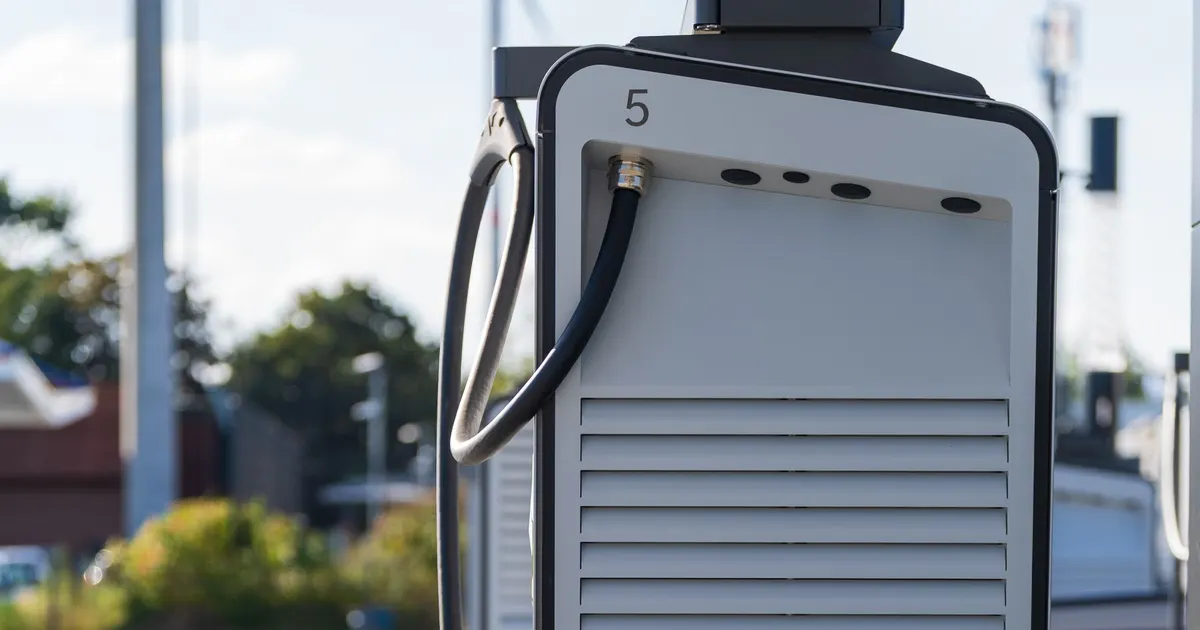
EV charging equipment is part electronics and part electrical hardware. A wallbox has a control board, a metering chip, relays, a residual current monitor and a cable, all inside a sealed enclosure. A DC fast charger adds power conversion modules, fans or liquid cooling and heavy cabling. For an electronics box build factory, this is a step up from consumer devices, because mains-level voltages, high current and outdoor use change what the line must control.
This article describes what to brief, how to think about assembly and test and who owns compliance. It does not replace your design engineering or certification plan, and approvals depend on your target market.
Two product classes
| Item | AC wallbox | DC charger or power module |
|---|---|---|
| Typical power | About 7 to 22 kW, single or three phase | Tens of kW up to hundreds of kW in cabinets |
| Main contents | Control board, contactor or relay, meter, residual current protection | Power modules, DC contactors, cooling, isolation monitoring |
| Assembly character | Electronics box build with mains wiring | Cabinet build with heavy wiring and busbars |
| Test demand | Insulation, protection checks, functional test | All of that plus load test and thermal run |
| Volume pattern | Hundreds to thousands per month | Lower unit count, higher value |
In the AC case the car carries the charger that converts AC to DC, and the wallbox acts as a smart, protected switch with communication. That is why it fits a box build factory well. A DC charger does the conversion itself and needs more power electronics and cooling skill.
Design points that affect assembly
- Creepage and clearance. Spacing between live parts and to the enclosure is set by the safety standard and the working voltage. Boards, terminal blocks and wiring must hold those distances after assembly, including after coating or potting.
- Heavy copper and busbars. High current uses thick copper traces or busbars. Soldering and torque methods differ from signal boards, and heavier thermal mass needs a matching reflow or selective soldering profile.
- Power terminals. Torque on power terminals needs control, because loose connections heat and fail. The torque control guide explains how to set and verify values.
- Thermal paths. Relays, power semiconductors and transformers need heat paths, often through a pad or paste to the enclosure. See the thermal interface guide.
- Ingress and impact. Outdoor units commonly target IP54 to IP65 and an impact rating. Gaskets, cable glands, breathers and the closing torque matter for the rating.
- Conformal coating or potting. Used for humidity and condensation, with masking of connectors and test points.
Protection and safety functions
A charger has to detect faults and stop energy flow. Typical functions the factory must verify on each unit:
- Residual current detection, including DC leakage, to the standard that applies
- Ground continuity and protective earth monitoring
- Contactor welding detection
- Overcurrent and temperature protection
- Communication with the vehicle through the pilot signal
- Emergency stop or interlocks where fitted
The design owner defines these functions and limits. The factory must test them according to a written procedure and keep records, not just apply a general “power-on” check.
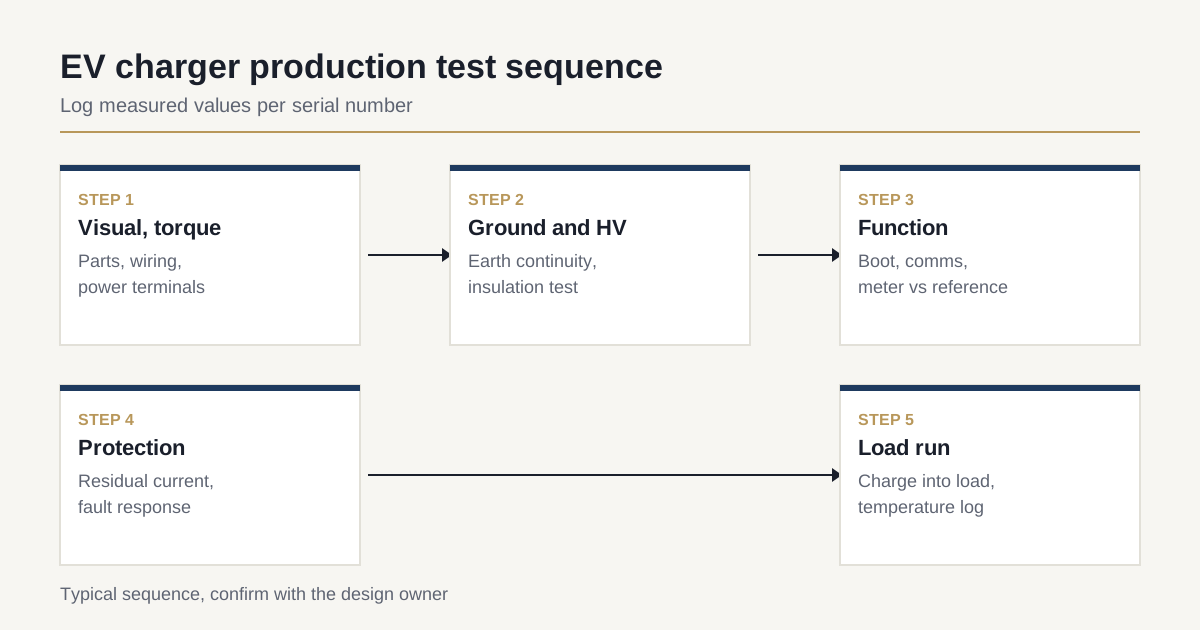
Production test plan
| Step | What it checks |
|---|---|
| Visual and torque | Parts, wiring, terminal torque, labels |
| Ground continuity | Low resistance from enclosure and exposed metal to the earth terminal |
| Insulation or high-voltage test | Isolation between live parts and earth, at the level the design and standard require |
| Functional test | Boot, display, communication, meter reading against a reference |
| Protection checks | Residual current and fault response with a simulator |
| Load run | Charging into a load or vehicle simulator, with temperature monitoring |
| Final inspection | Seals, closing torque, labels, packing |
High-voltage tests need trained staff, safe fixtures and calibrated equipment. Ask how the factory protects operators, how test limits are set and how the equipment is calibrated. The functional test and burn-in guide covers fixtures, burn-in and logging. A load test rack with a vehicle simulator or load bank is a significant investment, so check what the factory has before you choose it.
Metering, communication and software
Many chargers include an energy meter, a network connection and a backend protocol, such as OCPP. Design and certification of the meter, if used for billing, follow the rules of the target market. The factory should calibrate or verify meters against a reference, write the calibration constants to memory and log them per unit. Firmware loading and serial control follow the same principles as other connected products, as described in the firmware programming guide.
Compliance: who owns what
The brand owner is responsible for safety approvals, EMC, connector and plug compliance, market registration and any grid or metering rules. These depend on the target market, with different standards in North America, Europe, Japan and elsewhere. The factory builds units to the approved design. Agree these rules:
- A frozen approved BOM and approved vendor list for safety-critical parts such as relays, contactors, protection devices, cables and the enclosure
- Change control for any substitution, including the same part from a different maker
- Marking and labeling control, with the label content approved by your certification body
- Retained samples and records for investigations
- A rule for notification if a component supplier changes materials
Pilot, ramp and warranty thinking
A new charger usually starts with an engineering build, a pilot for certification samples and a controlled ramp. Field failures cost far more than for consumer goods, because service calls involve technicians and sites. Add burn-in or a thermal soak to the pilot, then decide whether it stays in production. Keep records so that a field failure can be traced to lot, test result and component batch.
Field failures and what to design into the build
Chargers sit outdoors, in car parks and garages, with heat, rain, dust and power surges. Typical field failures include relay or contactor wear, moisture ingress through glands, loose power terminals, overheating from poor thermal contact and communication faults caused by firmware. Ask the factory how each of these is covered in the build and test plan, for example torque marks on power terminals, a leak test or a spray test sample for ingress, a thermal check under load and a firmware version check against the approved release. Keep a log of serial numbers with the relay and meter lot, so that a field issue can be traced to a batch. Plan a sample of units for a longer soak test during the pilot, to see early failures before they reach a site.
What to put in your RFQ
- Product class, power rating, phases and target markets
- BOM with safety-critical parts named and alternates controlled
- Drawings for the enclosure, wiring, busbars and labels
- Test plan with limits, equipment needs and records
- Coating, potting and ingress requirements
- Component sourcing model, with lead-time risks listed
- Pilot size, ramp plan and annual volume
The vetting checklist covers how to check a factory’s records and test capability. boxbuildvn.com is a matching service and does not build or certify chargers. Send your package through the RFQ form and you are matched with up to 3 Vietnamese EMS factories, with a reply within 24 business hours. Free for buyers, NDA on request. The box build assembly overview describes the usual scope.
Frequently asked questions
Can an EMS factory build both AC and DC chargers?
Some can build AC wallboxes, since they use control boards, contactors and metering in a sealed box, while DC chargers need heavier power stages, cooling, high-current wiring and load test equipment. Ask each factory for experience with your product class, the maximum power it can test and how it handles high-voltage safety on the line.
Who is responsible for EV charger certification?
The brand owner that sells the product. Safety, EMC, connector and market approvals depend on the design and the target market, and the owner commissions the tests. The factory builds production units to the approved bill of materials and process, with change control, so units match what was tested.
What production tests are typical for a charger?
Common tests include a visual and torque check, insulation or high-voltage test, ground continuity, an operational check of the control and communication, a protection function check and a run under load. Some products add burn-in. Ask the factory to log measured values and to keep the test equipment calibrated.