- Torque is a proxy for clamp load, and the right value depends on the screw, the material it enters and the joint, so it has to be set by a joint test, not copied from a table.
- Plastic bosses strip or crack when over-torqued and loosen when under-torqued, so many box builds use a low torque with a controlled driver.
- Electric drivers with torque monitoring, screw counting and calibration records make fastening repeatable.
- Write the torque, tolerance, tool type and calibration interval on the assembly drawing or work instruction.
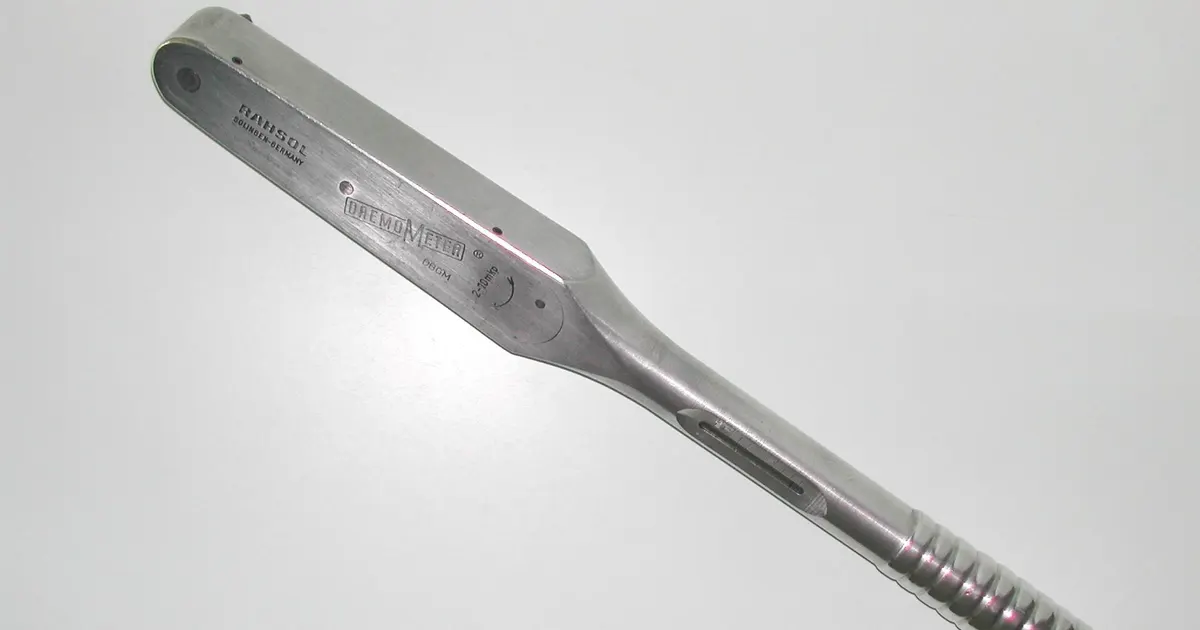
A screw looks like the simplest part of a box build, until an enclosure rattles, a ground lug works loose or a plastic boss cracks after shipping. Fastening is where the electronics meet the mechanics. The torque applied during assembly decides whether the joint holds, whether the plastic survives and whether the electrical ground path stays good.
This article covers how torque relates to clamp load, typical ranges for common screws, how plastics change the picture and which controls to specify. Figures are typical starting points and do not replace a joint test on your parts.
What torque really controls
When you tighten a screw, most of the torque goes into friction under the head and in the thread. Only a fraction becomes clamp load, the force that holds the parts together. That is why the same torque can give different clamp loads with a dry steel screw, an oiled one, a plated one or one with thread locker. Torque is a convenient proxy, and it works when everything else in the joint is controlled.
Where precision matters, factories also watch the angle of rotation. A torque and angle curve shows if a screw enters a hole with burrs, a stripped thread or a missing part.
Typical starting ranges
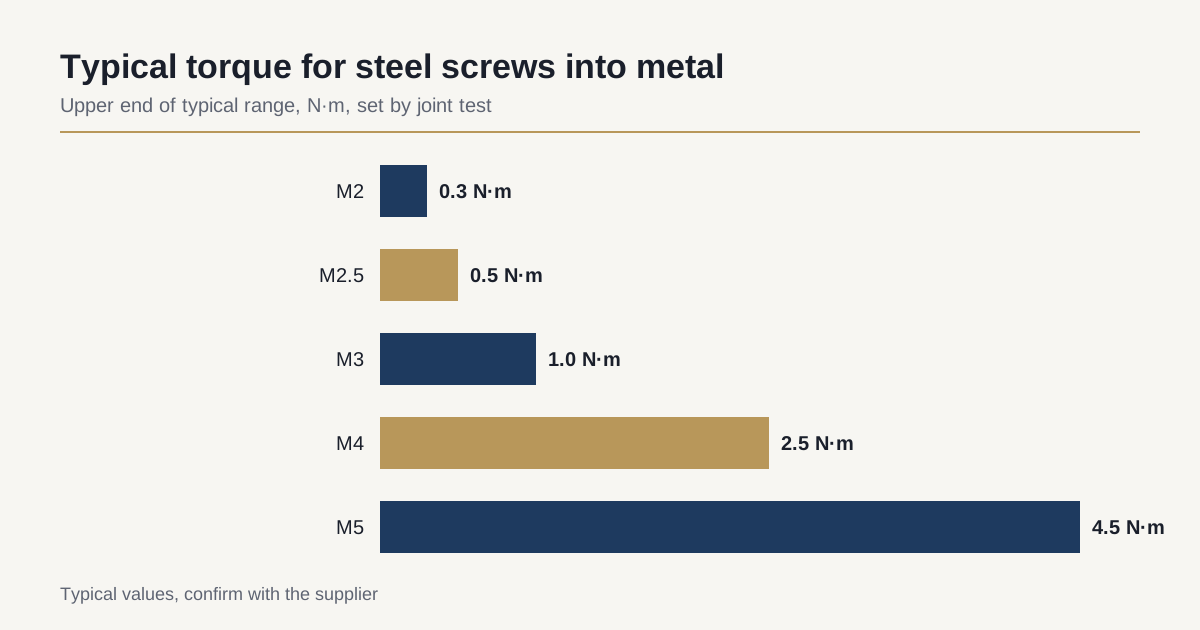
The table gives indicative ranges for clean steel machine screws into a rigid metal thread, and for self-tapping or thread-forming screws into plastic bosses. Material grade, boss geometry and wall thickness shift them, so confirm each by test.
| Screw size | Into metal, typical N·m | Into plastic boss, typical N·m | Common use |
|---|---|---|---|
| M2 | 0.15 to 0.30 | 0.10 to 0.20 | Small PCB mounts, sensors |
| M2.5 | 0.25 to 0.50 | 0.15 to 0.30 | PCB standoffs, connectors |
| M3 | 0.50 to 1.00 | 0.20 to 0.50 | Enclosure halves, PCB, heat sink |
| M4 | 1.20 to 2.50 | 0.60 to 1.20 | Brackets, power parts |
| M5 | 2.50 to 4.50 | Rare | Frames, ground studs |
Treat these as the start of a discussion. Many data sheets for connectors, power modules and heat sinks give their own maximum torque, which wins over a generic table.
Plastic bosses are the weak point
Plastics creep under load, which means clamp force falls over time. A boss tightened too hard can crack or strip right away or after a few weeks. A boss tightened too softly can loosen with vibration. Good practice includes:
- Use a screw designed for plastic, such as a thread-forming type, with the geometry the resin supplier recommends
- Set the boss hole diameter and depth from the supplier’s guidance, and check them on first articles
- Use a low torque with a controlled driver and a slow speed, to avoid heat build-up that softens the thread
- Avoid re-using a boss many times for rework, because repeated tightening wears the thread
- Check whether glass-filled grades need a different hole size
Tell the factory how many times a unit may be opened for repair, since it affects both the screw type and the boss design. Resin choice also changes the picture, which the guide to ABS, PC and PC/ABS covers.
Tool types and what they offer
| Tool | Strength | Limit |
|---|---|---|
| Mechanical clutch driver | Simple, cheap | Torque drifts with wear, no data |
| Electric driver with torque control | Repeatable, adjustable, programmable | Needs calibration and a power supply |
| Electric driver with torque and angle monitoring | Detects cross threading and missing parts | Costs more, needs setup |
| Fixed station with screw feeder | High speed, repeatable | Setup time, best for stable designs |
| Hand torque wrench | For ground studs and large bolts | Operator dependent |
For electronics sizes the common choice is an electric driver with torque control. The driver should be matched to the torque range, and a tool used near the top or bottom of its range is less accurate.
Calibration and verification
A torque tool that is never checked is a guess. Ask for:
- A calibration certificate for each tool that will build your product, traceable to a recognized lab
- A rule for how often tools are calibrated, and a quick check with a torque tester at a shorter interval, such as each shift
- A procedure for a tool that fails the check: stop, re-verify and review units built since the last good check
- Standards the factory follows for the tools, such as ISO 5393 for rotary tools or ISO 6789 for hand tools, if the factory chooses to cite them
Process capability matters too. Some customers ask for a capability index on critical joints, measured on a sample of units, though it only makes sense on joints where torque is critical.
Thread locking, washers and ground paths
- Thread locker. A liquid anaerobic compound or a patch on the screw prevents loosening. It adds a cure time and can complicate rework, so specify it only for joints that need it.
- Washers. Spring or toothed washers help vibration and electrical bonding, while flat washers spread load on thin sheet metal.
- Grounding screws. Ground lugs need a clean, bare contact surface, a defined torque and often a toothed washer. A painted surface under the lug breaks the ground path.
- Torque marking. A paint stripe across the screw head and the part shows a screw has been tightened and has not moved. It is a visual check, not a torque measurement.
Poka-yoke: fewer ways to get it wrong
Simple mistake-proofing steps reduce defects at little cost:
- Screw counting by the driver, with an alert if the count is wrong
- Kitted screws in a dispenser that holds only the right number
- Different screw sizes in clearly separate bins
- A fixture that holds the part in the correct position
- A final check of screw presence with a camera or a quick visual step
Where this sits in the program
Fastening affects cost through assembly minutes: more screws and more steps mean more labor. Design for fewer screws, or for snap fits, when the product allows it. The box build cost guide shows how labor fits in the cost buckets. Cable routing next to screws matters too, because a pinched cable is a common failure, as the wire harness guide explains.
Common fastening problems on the line
A few failure patterns account for most fastening complaints. Cross-threaded screws show up as a torque curve that rises too early. Stripped plastic bosses show as a torque that drops suddenly. Loose screws after vibration point at too little clamp load, a missing washer or the wrong thread locker. Missing screws are found at final inspection, or in the field. Ask the factory to review these patterns in its first article report and to show how its driver settings, fixtures and counting logic prevent each one. For critical joints, request a sample of units with the screws removed and re-measured, so you see the real torque that remains after a few days.
Checklist for your drawing and RFQ
- Torque value and tolerance for each fastener type, set by a joint test
- Screw type, thread locker and washer per joint
- Driver type, speed and torque monitoring requirement
- Calibration rule, check interval and records to be shared
- Screw counting or other mistake-proofing at the station
- Rework limit for plastic bosses
- Ground joints: surface prep, washer type and torque
boxbuildvn.com is a matching service and does not assemble units itself. Send your drawings and assembly notes through the RFQ form and you are matched with up to 3 Vietnamese EMS factories, with a reply within 24 business hours. Free for buyers, NDA on request. The box build assembly overview lists what factories usually cover from kitting to final pack.
Frequently asked questions
Can I use a standard torque table for my screws?
A table gives a starting range for a clean steel screw into a metal thread. Your joint may differ: plastic bosses, thin sheet metal, lubricants, coatings and thread locker all change the right value. Have the factory run a joint test, find the stripping and loosening torques and set the working value with margin on both sides.
How often should torque drivers be calibrated?
The interval depends on use and the factory's quality system, with common practice being a periodic calibration plus a quick daily or per-shift check with a torque tester. Ask for the calibration certificates of the tools that will build your product and for the check log. Tools that are dropped or fail a check should be pulled and re-verified.
What is the benefit of counting screws?
A missing screw is a common box build defect and is hard to see once the unit is closed. A driver that counts screws and signals when the count is wrong, or a station that blocks the next step until all fasteners are logged, removes that failure with little cost.