- ABS is the low-cost, easy-to-mold choice, PC adds impact strength and heat resistance, and PC/ABS blends the two and is the usual middle path for housings.
- Flame rating, heat deflection, impact and UV behavior should be matched to the product's real conditions, using the supplier's datasheet for the exact grade.
- Flame retardant grades are needed for many electronics housings, and the rating depends on the grade and wall thickness.
- Specify the grade, the flame rating at the wall thickness used, color and any approved alternate in the RFQ.
Opening a datasheet for enclosure plastics feels like reading a menu in a foreign language. ABS, PC, PC/ABS, ASA, with grade numbers and flame ratings on top. For most electronics housings the realistic choice is between three resins, and a few properties decide among them: heat, impact, flame rating, finish and cost.
This guide compares ABS, PC and PC/ABS for electronics enclosures and gives a list of what to specify in a box build RFQ. Property values here are typical for the resin families. Real grades differ, so always work from the supplier’s datasheet.
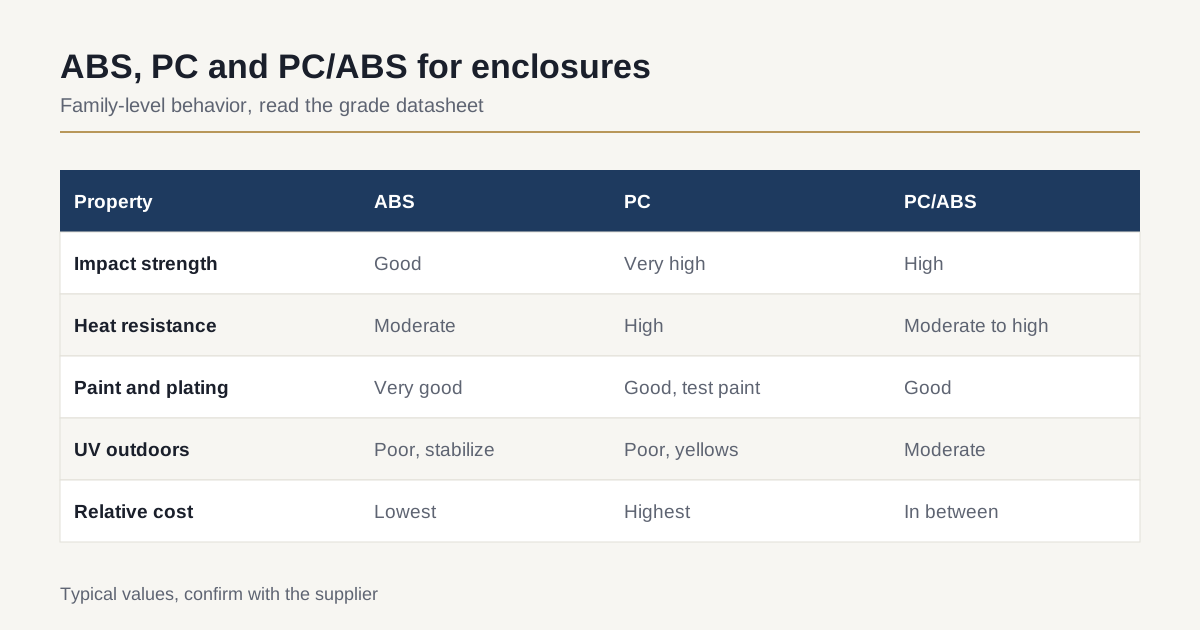
The three resins in one table
| Property | ABS | PC | PC/ABS |
|---|---|---|---|
| Impact strength | Good | Very high | High |
| Heat resistance | Moderate | High | Moderate to high |
| Dimensional stability | Good | Good | Good |
| Surface finish, paint and plating | Very good, widely used for plating | Good, needs care with some paints | Good |
| Flame retardant grades | Available | Available | Widely available, common for housings |
| UV outdoors | Poor without stabilizer | Poor without stabilizer, yellows | Moderate, needs stabilizer |
| Chemical and stress cracking | Weak against some solvents | Sensitive to certain oils and cleaners | Better than PC alone |
| Relative cost | Lowest | Highest | In between |
| Typical use | Consumer cases, toys, panels | Transparent covers, rugged housings | Laptop, charger and industrial housings |
The table shows the families. A specific grade can break these patterns, for example a high-heat ABS or a PC with extra impact modifier.
ABS: the low-cost default
ABS molds easily, gives a good surface and takes paint, texture and plating well. It is usually the cheapest of the three and widely stocked, and it is common for consumer products and low-power equipment. It does not take heat as well as PC, so check the heat deflection temperature against internal hot spots, and the temperature in a closed car or a sunlit window. UV weathering is a weakness for outdoor use.
PC: strength and clarity
Polycarbonate gives high impact strength, higher heat resistance and the option of transparent parts, which is why it serves for covers, light pipes and rugged cases. It costs more, and is sensitive to stress and to some chemicals, such as certain cleaners, oils and solvents. Molded-in stress near screw bosses can lead to cracks months later, so boss design and screw torque matter, as the torque control guide explains. PC also yellows in sunlight without UV protection.
PC/ABS: the common middle path
The blend combines good flow and finish from ABS with strength and heat resistance from PC. Many flame retardant grades exist, making it a frequent choice for enclosures of chargers, controllers, networking gear and appliances. Properties shift with the ratio of the two parts, so compare grades, not the label. It usually costs more than general ABS, less than PC.
Flame ratings and how to read them
Safety standards for electronics usually require flame retardant materials for enclosures above certain power levels. A common way to describe this is the UL 94 classification, such as HB, V-2, V-1 and V-0, where V-0 is the strongest of the vertical burn classes. The rating applies to a stated minimum wall thickness. A grade rated V-0 at 1.5 mm may only reach V-1 or less at 0.75 mm. Always write rating and thickness together.
Other tests may apply, such as glow wire tests used by some product safety standards, and the flame retardant system may need to meet halogen-free or RoHS requirements in some markets. Your test lab or certification body can tell you which test matters for your product, and the resin supplier should provide the datasheet and declarations.
Heat and temperature
Look at two numbers: the heat deflection temperature, and the continuous use temperature given on the datasheet or in a UL file. The enclosure often sees higher temperatures than the room, because of power components inside, solar load or a closed vehicle. If a hot spot sits near a boss or a wall, leave air space or a heat shield and test a first article under worst-case load. The thermal interface guide describes the heat paths in the assembly.
Finish, paint and plating
ABS and PC/ABS take paint and texture well, and plated ABS is common for decorative parts. Some paints attack PC, so your painter should test a sample. For EMI shielding, conductive paint and plating adhere differently to different resins. Tell the factory early if the part will be painted, plated or laser marked, since resin and grade choice depends on it. Colored resins vary from batch to batch, so set a color tolerance with a physical master sample.
Cost and supply
Resin price changes with the market, and specialty flame retardant grades may cost more and have longer lead times. Factories in Vietnam often use imported grades from established resin makers, and sometimes regional equivalents. Ask which brand and grade the factory plans to use, and which alternate it proposes if supply is short. Do not accept a substitute resin without a documented approval, since it can change flame rating, color and fit. The box build cost guide shows where the housing sits in the total cost.
Tooling interaction
Resin choice affects the mold. Shrinkage differs between resins, so a mold is cut for a specific material, and switching resin later can mean mold changes. The mold steel and finish should suit the resin, especially for glass-filled or flame retardant grades that wear tools faster. Decide the resin before the mold design starts.
Common mistakes with enclosure resin
Three mistakes show up again and again in housing projects:
- Choosing by name. “PC/ABS” on a drawing covers dozens of grades with different flame ratings, heat deflection values and finish behavior. Name the grade or the datasheet.
- Quoting the flame rating without the thickness. A rating given for a 3 mm test bar says little about a 1.2 mm wall. Check the rating at the thinnest wall in your design.
- Forgetting regrind and color. Some factories add reground material from sprues and rejects. Decide whether regrind is allowed, at what share and whether it is allowed at all for a flame retardant grade, since it can change the rating and the color.
A short material review with the factory before mold design starts costs a few hours. A resin change after the mold is cut costs weeks. Ask for a molding trial report on first samples, with shrinkage measured on the critical dimensions, and keep one approved sample on file for color and texture comparison with later lots.
What to specify in the RFQ
- Resin family and exact grade, with an allowed alternate that needs your approval
- Flame rating and the wall thickness at which it applies
- Heat and impact requirements, with any drop test
- UV, chemical and cleaner exposure
- Color, texture, paint or plating, with a master sample
- Supplier datasheet and declarations such as RoHS, kept in the build file
- Rule for resin lot changes and re-approval
The RFQ checklist shows how to include these items in your package. boxbuildvn.com is a matching service and does not mold parts itself. Send the files through the RFQ form and you are matched with up to 3 Vietnamese EMS factories, with a reply within 24 business hours. Free for buyers, NDA on request. See the box build assembly overview for how the housing fits the rest of the program.
Frequently asked questions
Is PC/ABS always better than ABS?
Not always. PC/ABS offers better impact strength and heat resistance, and flame retardant grades are widely available, but it costs more than general ABS and can be harder to paint or plate in some grades. If an ABS grade meets your flame, heat and impact needs, it is the cheaper choice. Compare candidates by datasheet and not by name alone.
Why do some plastic housings turn yellow outdoors?
UV light degrades many resins. Polycarbonate and ABS yellow or chalk outdoors without stabilizers or a protective coating. UV stabilized grades or a different resin such as ASA are common for outdoor products. State the outdoor exposure in the RFQ, so the right grade and a test plan are quoted.
What flame rating does an electronics enclosure need?
It depends on the product standard, the power level and the market. UL 94 V-0 or V-1 are commonly specified for enclosures of mains-powered equipment, and the rating is given for a minimum wall thickness. Check the product safety standard and your test lab's advice, then specify the grade and the thickness for which it is rated.