- ANSI/ESD S20.20 is a program standard: it asks a factory to document, train, test and audit its ESD control, not just to buy wrist straps.
- The core of the program is an ESD protected area with grounded people, grounded work surfaces, controlled insulators and protective packaging.
- Daily and periodic checks of wrist straps, footwear and surfaces are the evidence to ask for.
- Check any ESD certificate with its issuer, and look at the floor yourself on a video walkthrough or visit.
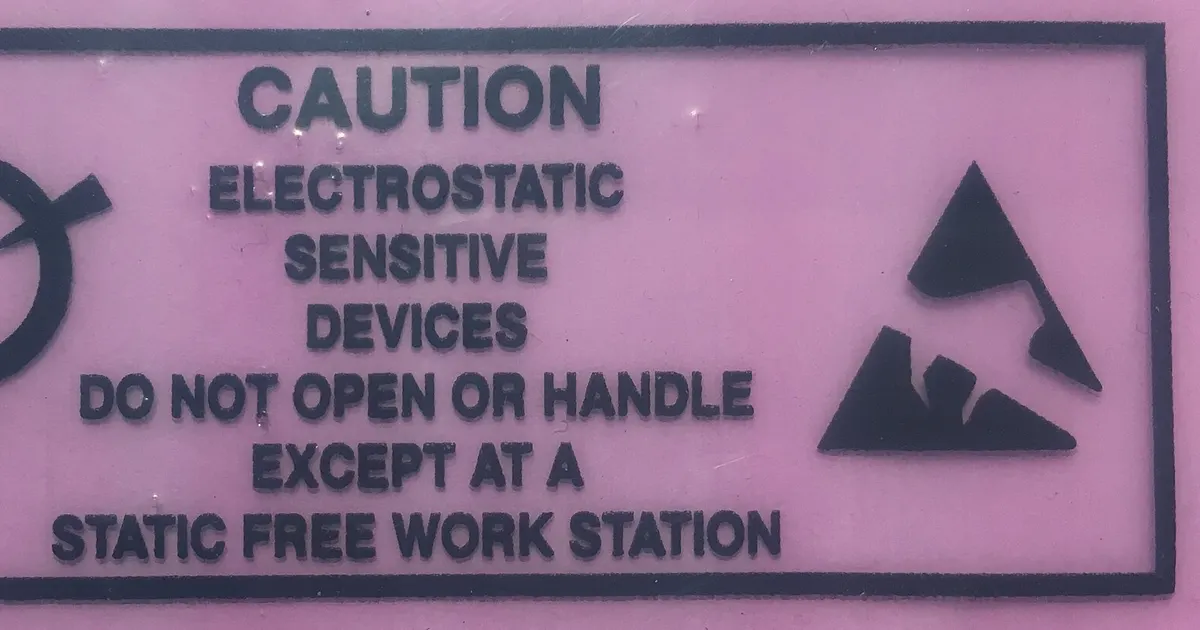
Electrostatic discharge damages electronic parts at voltages a person cannot feel. Some damage is immediate and shows up on the first test. Some is latent: the part passes, then fails in the field weeks later. A box build line touches the product at many points, from reels and trays to hand assembly, final test and packing, so ESD control has to work along the whole route.
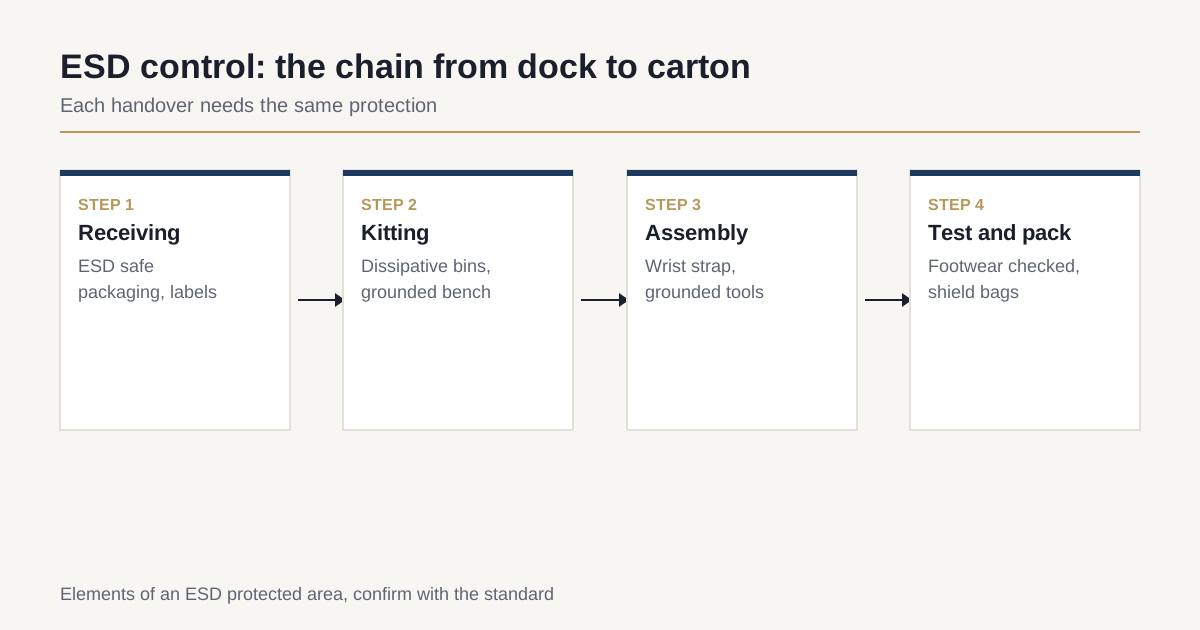
This article explains what ANSI/ESD S20.20 asks of a factory, the practical elements of an ESD protected area and what evidence to request from a Vietnamese EMS factory. Details and limits come from the standard itself, so read the current revision before writing requirements.
ESD in plain terms
Static charge builds up when materials touch and separate: a person walking, a plastic tray sliding, tape pulled off a roll. When that charge reaches a sensitive part, it discharges in nanoseconds. The strength of the part against discharge is classed by test models such as the human body model. Many modern ICs are damaged at levels well below what a person can feel, which is why control must be systematic.
What ANSI/ESD S20.20 is
ANSI/ESD S20.20 is a standard from the ESD Association for protecting electrical and electronic parts, assemblies and equipment. Its approach is a program: a factory builds an ESD control program, plans it, trains staff, checks that the program works and keeps records. It sets technical requirements for the ESD protected area, often called an EPA. IEC 61340-5-1 follows a similar structure.
Two points for buyers:
- The standard sets the sensitivity level it protects. The factory has to know the most sensitive part on your BOM and show that its controls cover it.
- The standard is about the program. A factory can own a lot of ESD equipment and still run a weak program, or the other way round.
The building blocks of an ESD protected area
| Element | What it is | What to look for |
|---|---|---|
| Personnel grounding | Wrist straps with a cord and a series resistor, or heel straps with ESD flooring | Wrist strap plugged in at the bench, not hanging loose |
| Work surfaces | Dissipative mat or bench top connected to ground | Ground cord attached, surface marked |
| Flooring | Dissipative or conductive floor, with footwear | Footwear test station at the entry |
| Insulators | Plastic parts, cups and tape cannot be grounded | Removed from the area, or neutralized with an ionizer |
| Ionizers | Blowers or bars that neutralize charge on insulators | Calibrated, with a maintenance record |
| Packaging | Shielding bags, dissipative trays and bins | Marked packaging used in transport and storage |
| Marking | Signs, EPA boundary, labels on products | Visible at the entry and on bags |
| Equipment | Tools, soldering irons, test fixtures grounded | Checked on a schedule |
Evidence worth asking for
Equipment is easy to photograph. Records show the program is alive. Typical items:
- Program plan. A document that names the standard, the revision and the people responsible.
- Training records. Every operator in the EPA trained, with a refresh interval.
- Daily wrist strap and footwear checks. A log or a test station that records pass and fail.
- Periodic checks. Surface resistance of mats and floors, ionizer balance and decay, and ground point continuity, on a stated schedule.
- Audit reports. Internal audits and corrective actions, plus any external audit.
- Corrective action. What happens when a test fails: the person is stopped, the product since the last good test is reviewed.
Ask to see a log from the past month, not only the template. If the factory claims third party certification to ESD S20.20, ask for the certificate, then verify the issuing body and the scope yourself. Never accept a PDF alone.
Where lines usually leak
Weak spots in box build plants are not at the SMT line, which tends to be well controlled. They tend to be at handovers:
- Receiving and warehouse: reels and trays pulled from outer cartons made of ordinary plastic
- Kitting: parts moved in common plastic bins
- Final assembly: operators who handle the enclosure and the board in the same step, with plastic fixtures or tools nearby
- Packing: boards placed in ordinary bags or foam
- Rework and repair stations, which sometimes sit outside the protected area
- Visitors and managers who walk through without footwear checks
When you watch a video walkthrough, follow one reel from the dock to the finished box and watch each handover.
Environment and humidity
Low humidity makes charge build-up worse, and many factories keep humidity in a defined range to reduce it. A humidity target helps but does not replace grounding and controlled insulators. Ask what range the plant keeps in the EPA and how it is logged, especially in air-conditioned clean areas.
How ESD links to the rest of the quality system
ESD control sits next to moisture control for sensitive ICs, component traceability and workmanship standards. The IPC-A-610 class guide covers how acceptance criteria are set. The vendor vetting checklist describes how to test a factory’s records on a past order. ESD results are one part of that picture, not a stand-alone pass or fail.
Common gaps found during audits
Auditors of ESD programs often report the same findings. Wrist strap checks are done but not recorded. Ionizers are fitted but never checked for balance. Operators wear straps but touch products with ordinary gloves or tools. Tote boxes and trays of unknown type circulate in the protected area. Visitors enter without a footwear check. Corrective actions are written but not closed. When you review a factory, pick two of these at random and ask for the evidence for the last month. A factory that can answer quickly, with a log and a name, has a working program. A factory that needs a day to find the record usually has a weak one, whatever certificate is on the wall.
What to write in the RFQ and quality agreement
- The ESD standard and revision you require, such as ANSI/ESD S20.20 or IEC 61340-5-1
- The sensitivity level of the most sensitive part, if known
- Requirement for ESD safe packaging during storage and shipment, including finished units
- Right to review ESD records on request, and to audit the area
- Corrective action rule when a test fails
- Required ESD marking on cartons if your customer needs it
boxbuildvn.com is a matching service. It does not audit factories or hold records for you, so you review the evidence with each factory directly. Send your requirements through the RFQ form and you are matched with up to 3 Vietnamese EMS factories, with a reply within 24 business hours. Free for buyers, NDA on request. The box build assembly overview shows the full scope a typical factory covers.
Frequently asked questions
Is ANSI/ESD S20.20 the same as IEC 61340-5-1?
They cover the same ground and are closely aligned, but they are separate documents with some differences in limits and wording. Factories serving US customers often cite ANSI/ESD S20.20, and others cite IEC 61340-5-1. Ask which one the factory works to, and which revision, and state the one you want in your quality requirements.
Does an ESD wrist strap protect every part on the line?
No. A wrist strap grounds the person, but chairs, tools, trays, packaging and insulating materials near the product are also sources of charge. A program covers all of them, which is why standards ask for a defined protected area, controlled insulators, ionization where needed and approved packaging.
How can I check ESD control without visiting the plant?
Ask for the program manual, the latest audit report, daily wrist strap and footwear test logs, and the training record format. A live video walkthrough of the receiving, SMT, assembly and packing areas shows grounding, markings and packaging in real use. Compare what you see with the written program.