- The strongest control is where parts are bought: manufacturers and their authorized distributors, with traceability back to the manufacturer lot.
- When a part must come from the open market, a staged inspection and test plan reduces the risk, from visual and marking checks to X-ray and electrical test.
- Standards such as SAE AS5553 and AS6081 describe avoidance and distributor practice and are a useful reference in a quality agreement.
- Write the rules into the RFQ: authorized sources, no broker buys without approval, a quarantine process and a reporting duty.
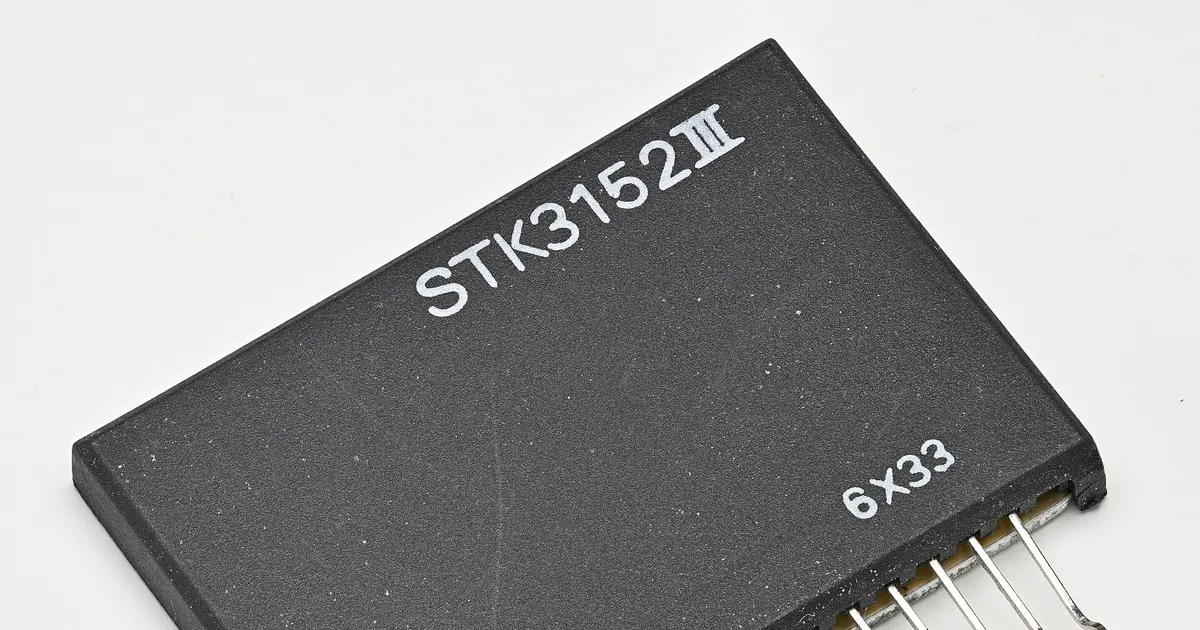
Counterfeit parts are a quiet risk in electronics supply. A relabelled chip that passes incoming checks can fail in a customer’s product months later, and a recall of a box build costs far more than the parts saved. The risk rises when parts are scarce, prices spike and someone offers stock from an unknown source.
This article lays out how EMS buyers reduce the risk: control of sources, spotting warning signs, a staged inspection and test plan and the clauses to write into an RFQ. It describes common practice and is not legal or safety advice. Your own quality team or test lab sets the final plan for regulated products.
What counterfeit means in practice
The term covers several kinds of fake or misrepresented parts:
- Re-marked parts. Old or lower-grade devices relabelled as a higher grade or a newer date code.
- Recycled parts. Used chips pulled from scrap boards, cleaned and sold as new.
- Remanufactured or cloned parts. Copies with a different die inside.
- Out of spec parts. Rejected or failed parts that left the manufacturer’s lot and entered the market.
- Wrong or empty packages. Shells with no die, or a different part inside.
- Forged documents. Certificates of conformance with no real backing.
Other quality escapes, such as parts stored badly or exposed to moisture, are not counterfeit, but the controls overlap.
Control the source first
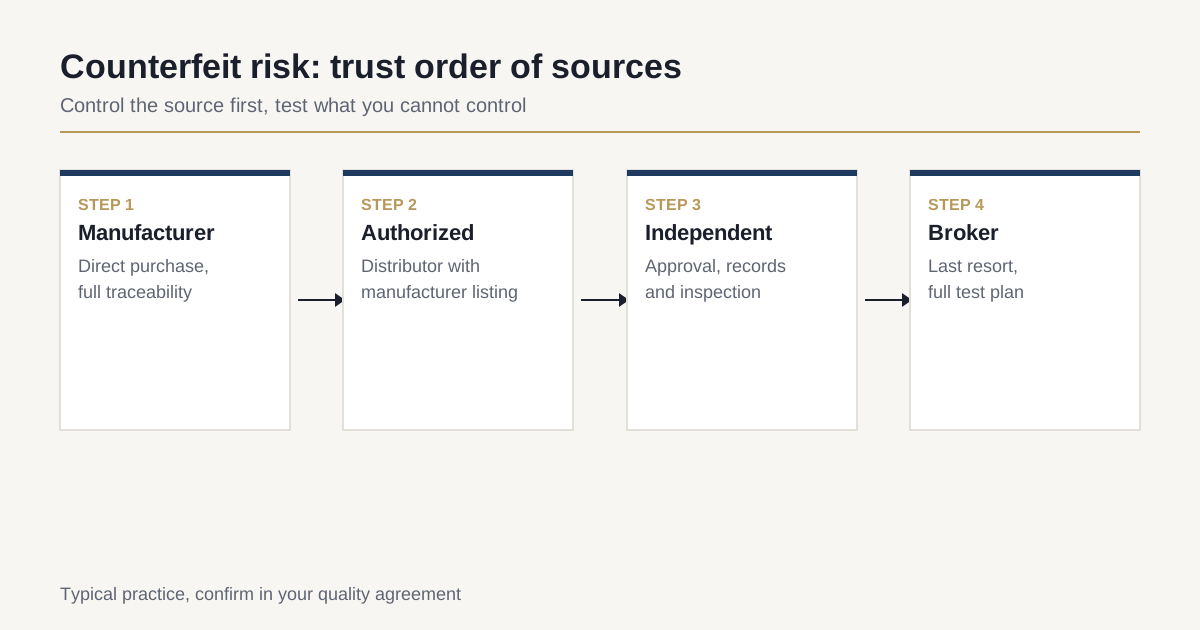
Testing finds problems after you have paid for the parts. Source control prevents them. A sensible order of trust:
- Component manufacturer, direct.
- Franchised or authorized distributors, with a letter or listing from the manufacturer.
- Independent distributors, only after approval, with traceability and inspection.
- Brokers and unknown sellers, only for last-time buys or allocation, with full testing.
For the factory’s own purchasing, ask for its approved vendor list and its rule on broker buys. Ask who approves an exception. The vetting checklist covers how to test purchasing practice. The guide to turnkey and consigned sourcing shows how the buying model changes who owns this risk.
Traceability documents that matter
For each lot, the buyer should be able to see:
- Manufacturer name, part number, date code and lot code on the label and on the part
- A purchase record from the distributor to the factory
- A certificate of conformance from the distributor, tied to the manufacturer’s lot
- Packing list and original manufacturer packaging, such as sealed reels and moisture bags
- Records of storage and handling at the factory
Documents can be forged, so check them against the physical goods: label fonts, barcodes, date codes and the part marking should match.
Red flags
- Price far below the market for a part that is in short supply
- Date codes spread over many years on one reel or in one lot
- Packaging that looks reworked, different reel colors or label quality, loose tape, missing moisture barrier bags
- Pins that look re-tinned, pitted or cleaned, with scratches or sanding marks on the top
- Marking that smears with a solvent test, or fonts that differ from known good parts
- A seller that refuses to name its source or to allow testing
- Pressure to buy right now
None of these proves a counterfeit alone. Several together call for a hold and a test.
A staged inspection and test plan
Standards such as SAE AS6081 describe test steps for distributors, and the IDEA association publishes visual inspection criteria. A typical staged plan runs from cheap to costly:
| Step | What it finds | Typical use |
|---|---|---|
| Documentation check | Missing or inconsistent paperwork | Every lot |
| External visual under a microscope | Sanding, re-marking, damaged leads, wrong logo | Every broker lot |
| Marking permanency test | Fresh ink or coating over the original marking | Sample of broker lots |
| X-ray | Missing die, wrong die size, wire bond layout | Higher-risk parts |
| Electrical test | Wrong function, parametric drift, out-of-spec parts | Critical parts, sample or full |
| Decapsulation | Die markings and construction | Sample, destructive |
Costs and turnaround vary by lab and part, from a few days for visual and X-ray checks to longer for full programs. Plan the time into the schedule, and decide before buying how many parts get tested and how many are scrapped by testing.
Standards worth knowing
SAE AS5553 sets requirements for avoiding, detecting, mitigating and disposing of counterfeit electronic parts, and AS6081 covers distributor practices. Government-industry programs such as GIDEP circulate alerts in some sectors. Defense and aerospace customers often require these standards by contract. For other markets they are a helpful reference when you write quality requirements, even if they are not mandatory. Do not assume that a factory follows them unless it can show its procedure.
Handling a suspect lot
Agree the steps before the problem happens:
- Quarantine the lot, physically marked and separated
- Notify the buyer within a stated time
- Test or return, as the contract says
- Keep the evidence, such as photos, reports and packing
- Report to the distributor and, where needed, to industry alert services
- Do not return suspect parts to the open market
Parts shown to be counterfeit should be removed from circulation, according to the contract and local law.
Planning around shortages
Counterfeit offers rise when a part goes on allocation, and the pressure on the schedule makes a risky purchase look attractive. A few planning habits reduce that pressure. Review the BOM for single-source and long-lead parts before the first order, and ask the factory to flag any part with a lead time above 20 weeks. Qualify a second source for passives and common ICs while there is time. Keep a modest buffer of critical parts bought from authorized sources, and agree how it is stored and counted. Share your forecast with the factory so that it can place orders early, and treat a last-minute broker request as a trigger for a call between your team and the factory’s purchasing lead before anything is bought.
Clauses for your RFQ and quality agreement
- Components bought only from manufacturers or authorized distributors, unless you approve in writing
- Broker purchases need written approval and an inspection plan, with cost allocation stated
- Certificates of conformance and traceability to the manufacturer lot kept for a stated period
- Right to review purchase records and to inspect incoming material
- Quarantine, notification and disposal steps for a suspect lot
- Flow-down to the factory’s suppliers
The RFQ checklist shows where to place these terms. boxbuildvn.com is a matching service and does not buy or inspect parts itself, so you agree the controls directly with each factory. Send your BOM through the RFQ form and you are matched with up to 3 Vietnamese EMS factories, with a reply within 24 business hours. Free for buyers, NDA on request. The box build cost guide explains how part sourcing affects the quote.
Frequently asked questions
What is the safest way to avoid counterfeit parts?
Buy from the component manufacturer or its authorized distributors and keep documents that trace each lot back to the manufacturer. Most counterfeit parts enter through unauthorized brokers during shortages. If a part is allocated, plan early, accept longer lead times or qualify an alternate part, instead of buying from an unknown source.
Can counterfeit parts be detected by looking at them?
Sometimes. Visual inspection under a microscope can reveal sanded or re-marked tops, uneven fonts, wrong logos or mixed date codes. But good counterfeits pass visual checks, which is why a plan also includes marking permanency tests, X-ray, decapsulation on a sample and electrical testing. No single test is enough.
Who pays for testing of parts bought from brokers?
This must be agreed before the purchase. Many agreements make the buyer approve any broker purchase and bear the extra inspection cost, since the choice is driven by an allocation or a schedule need. Without a clause, the factory and the buyer may argue about the bill when a lot fails and the line is waiting.