- Consumer products are judged by look, sound and feel, so the build needs a signed golden sample, a cosmetic standard and an acoustic test limit, not only electrical pass criteria.
- Acoustic checks such as frequency response, distortion and rub and buzz catch faults that a power-on test cannot, and need a quiet test box and a reference.
- Retail packaging, manuals and regional variants add as many steps as the electronics, and each variant needs its own part number and label control.
- Volumes are higher and margins thinner than industrial products, so yield, takt time and rework rate drive the unit cost.

Speakers, soundbars, smart plugs, hubs, cameras and displays share a simple idea: a PCBA in a good-looking case with a retail box. The manufacturing task is not simple. A single scratch on a glossy panel, a rattle at a certain frequency or a mismatched plug in a regional box leads to returns. The line must deliver the same look, sound and feel on unit 10,000 as on the approved sample.
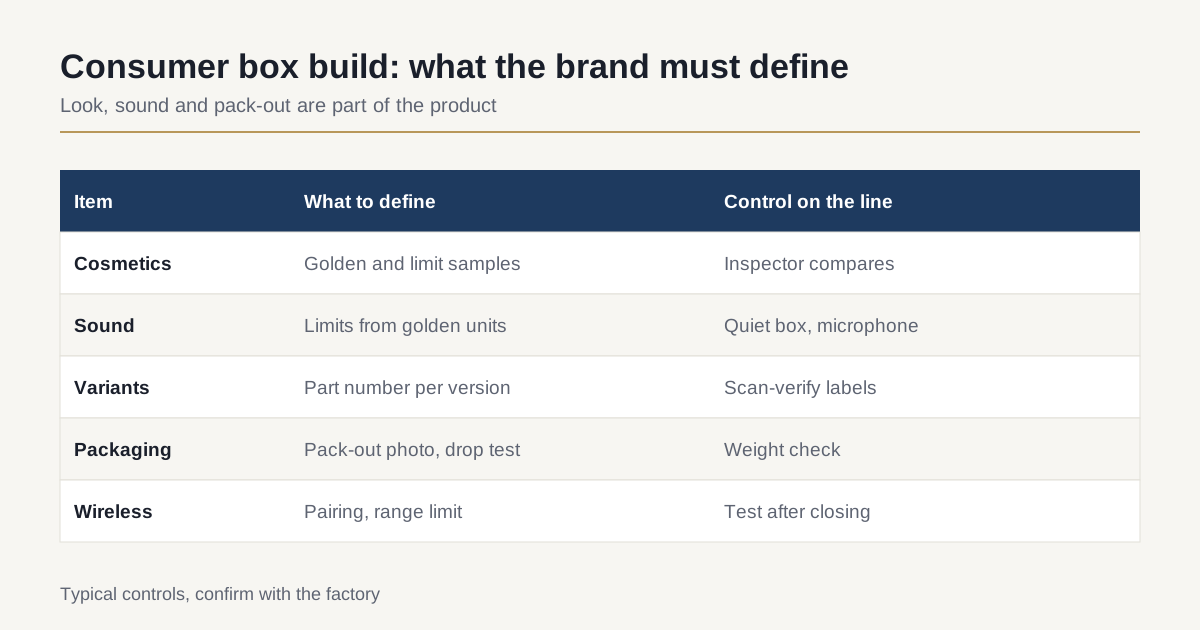
This article describes how a Vietnamese EMS factory builds consumer audio and smart home products, with the controls a brand should specify. Typical values are given for planning only, and they depend on the product and factory.
What sets consumer products apart
- Appearance counts. Surface finish, gaps, color match and printing are part of the product.
- Sound and feel. Acoustic response, button feel and fit are judged by users.
- Packaging is a product. Retail boxes, inserts, manuals and accessories can have as many parts as the unit.
- Variants. Plug types, languages, voltage labels and approvals multiply part numbers.
- Volume and cost. Thousands to hundreds of thousands of units, with small margins per unit.
- Wireless. Bluetooth, Wi-Fi and other radios need test and certification handled by the brand.
Cosmetic standards and golden samples
Define the cosmetic standard before the pilot. The package normally includes:
| Item | Content |
|---|---|
| Golden sample | Approved reference unit and packaging |
| Limit samples | Examples of the worst acceptable defect and the first reject for scratches, dents, gaps, color and print |
| Defect classes | Critical, major and minor, with examples |
| Viewing conditions | Light level, distance, angle and time for inspection |
| Sampling plan | Lot size and AQL levels for final inspection, based on a standard sampling table |
| Color control | Reference chips or a sample, with tolerance measured by a color meter if needed |
Many consumer programs use acceptance sampling tables, such as those in ISO 2859-1, with separate AQL levels for major and minor defects. The levels are a commercial choice that you agree with the factory. Keep photo records of the limit samples at the line, and update them when the brand approves a change.
Acoustic and wireless test
A power-on test does not tell you how a speaker sounds. Typical production steps for an audio product:
- Acoustic test in a quiet box. A test signal plays, a calibrated microphone measures the response and software compares it with limits from golden units.
- Distortion and noise. Total harmonic distortion at set levels, plus a sweep to find rub and buzz.
- Polarity and channel check. Left and right and phase are correct.
- Sensitivity. Output level for a given input, within a window.
- Leak and seal check. For sealed enclosures and ported designs, an air leak test or a pressure test catches missing gaskets.
- Wireless check. Pairing, range or throughput with a reference device, in a shielded box if possible.
- Button and LED check. Operator or camera confirms.
Ask who builds and calibrates the test fixture, and how the microphone is verified. Operator listening can supplement an automated test but should not replace it. The functional test guide covers fixtures, logging and burn-in.
Smart home specifics
Smart plugs, sensors and hubs carry radios and sometimes mains voltage. Extra points:
- Mains-connected products need insulation tests and strict control of safety-critical parts, with an approved vendor list
- Cloud pairing credentials and device identity are loaded during production, as the firmware programming guide explains
- Radio performance can change when the case closes, so test after final assembly
- Labels often carry QR codes for pairing, and a wrong code is a service nightmare, so scan-verify them
Packaging and variants
Packaging steps usually include unit protection film, accessory bag, cable, manual, inserts, box and master carton. Control points:
| Control | Why |
|---|---|
| Part number per variant | Avoids mixing plug types and language manuals |
| Label check by scanner | Compares box label, unit label and serial |
| Line clearance on changeover | Removes leftovers from the previous variant |
| Drop and vibration test on sample packs | Checks that the pack protects the unit in transit |
| Weight check | Catches missing accessories |
Ask for a pack-out photo for each variant and a standard for the master carton, including pallet pattern. Retail packaging often has print lead times of several weeks, so plan them before the pilot build.
Regional approvals and labels
The brand is responsible for approvals and labeling in each market, such as safety, EMC, radio, battery rules and local marks. Provide the factory with the approved label artwork and placement per variant, and lock them under change control. Do not let the factory choose label content.
Yield, takt time and cost
At consumer volumes, small losses add up. The factory’s yield at each station, the rework rate and the cycle time of the slowest station set the unit cost. Ask for a line balance, the expected first-pass yield and the plan for the slowest step, which is often acoustic test, programming or packing. The box build cost guide shows how labor, test and packaging fit in the cost.
Pilot and ramp
A typical ramp has an engineering build, a pilot with full packaging, a controlled start and then scale. Use the pilot to approve the golden sample, test limits and the pack-out. Stop and review after each stage, and agree the exit criteria, such as yield and defect rates, in writing.
Returns, warranty and what the line can do about them
For consumer products, most returns come from a small group of causes: cosmetic damage in transit, pairing or connectivity faults, battery problems and user confusion. The line can reduce the first three. Ask the factory to track field return reasons back to lot and station, and to share the data with you each month. A recurring scratch pattern points at a handling step. A rise in pairing faults after a firmware change points at the release. Agree a response time for containment actions, and a clear rule for who pays for rework when a lot proves defective. Keep a retained sample from each lot for later comparison, stored for a period you define in the agreement.
Checklist for your RFQ
- Product description, BOM, enclosure and packaging drawings
- Golden sample and cosmetic standard, with sampling plan
- Acoustic and wireless test limits, fixture owner and records
- Variants, labels, manuals and accessories with part numbers
- Approved vendor list for safety-critical parts
- Packaging tests and the shipping method
- Volume plan, ramp and forecast sharing
- Quality records per lot
boxbuildvn.com is a matching service and does not build or inspect products itself. Send your package through the RFQ form and you are matched with up to 3 Vietnamese EMS factories, with a reply within 24 business hours. Free for buyers, NDA on request. The box build assembly overview describes the usual scope of factories.
Frequently asked questions
What is a golden sample?
A golden sample is a unit approved by the brand as the reference for appearance, fit and function. It may be paired with limit samples that show the worst acceptable and the first rejected condition for a defect type such as a scratch or a gap. The factory keeps them at the line, and inspectors compare production units against them.
How is audio quality checked on a production line?
Usual checks play a test signal through the product in a quiet box and compare the measured response with limits set from golden units. Results cover frequency response, distortion, sensitivity and unwanted noise such as rub and buzz. Ask for a measurement microphone or a fixture with calibration records, not just an operator listening.
Who handles regional versions of the same product?
The brand defines the variants, such as plug type, voltage rating, language, labels and approvals. The factory controls them through separate part numbers, labels and packaging, and must prevent mixing at the packing station. Ask how each variant is identified and how the line is cleared when switching.