- Conformal coating is a thin polymer film that protects a populated board from moisture, dust and chemical contamination.
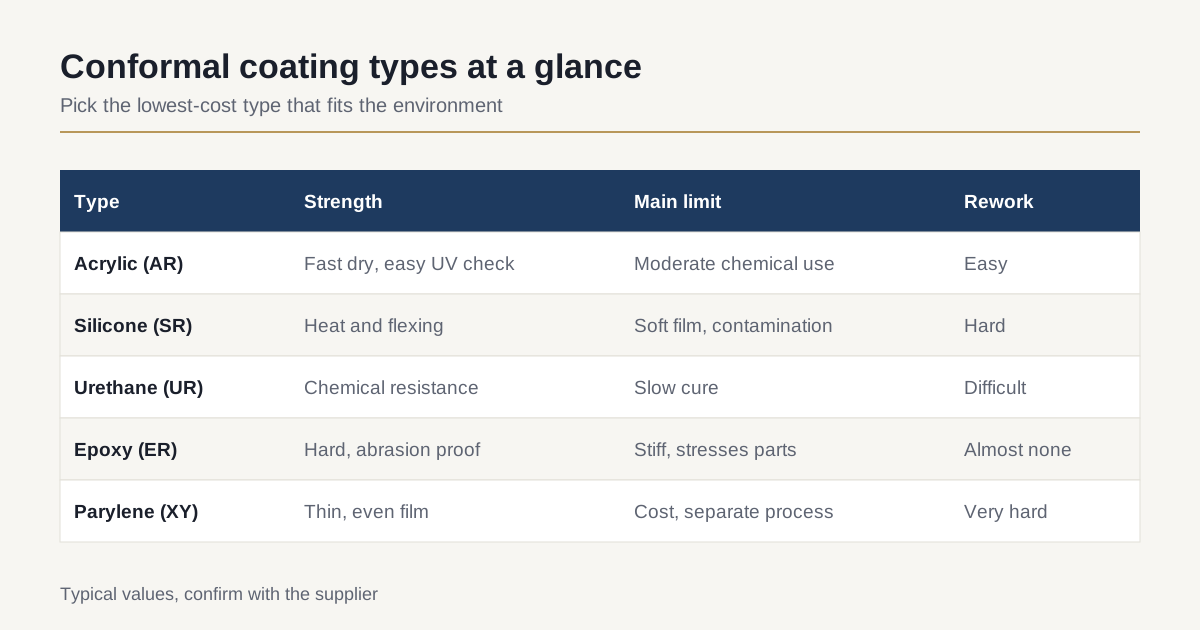
- Acrylic is easy to apply and rework, silicone tolerates heat and flexing, urethane resists chemicals, epoxy is hard and difficult to repair, and parylene is vapor deposited for the thinnest even film.
- The drawing must show keep-out zones for connectors, switches, test points and heat paths, with the coating type and thickness stated.
- Specify how the coating is checked, for example UV light for a tracer dye and a thickness measurement method.
A populated board that works on the bench can fail in the field after a few weeks of humidity, condensation or salt air. Conformal coating is the usual protection: a thin polymer film applied over the assembled board. It looks like a minor step in a box build. In practice it affects solder joint inspection, connector contact, test access, rework and cost, so it needs a clear spec.
This article covers the main coating types, how masking works, how thickness and coverage are checked and what to write in your RFQ. Treat all numbers as typical values and confirm them with the coating datasheet and your factory.
What conformal coating does and does not do
A conformal coating follows the contours of the board and components. Typical purposes:
- Block moisture and condensation from bridging closely spaced conductors
- Reduce corrosion on pads, leads and exposed copper
- Limit dust and contamination, and in some cases fungal growth
- Reduce the risk of dendritic growth and leakage at high impedance nodes
It does not make a board waterproof, it does not replace an enclosure with a proper ingress rating and it does not fix a contaminated board. Flux residue and fingerprints under a coating can cause the very failures it was meant to prevent, so cleanliness before coating counts as much as the film itself.
The five main coating families
The common families carry designation letters used in IPC-CC-830 and IEC 61086 style classifications: AR acrylic, ER epoxy, SR silicone, UR urethane and XY parylene.
| Type | Strengths | Limits | Rework |
|---|---|---|---|
| Acrylic (AR) | Fast dry, easy to apply, good moisture barrier, simple UV inspection | Moderate chemical and abrasion resistance | Easy with solvent |
| Silicone (SR) | Wide temperature range, flexible, handles thermal cycling | Soft film, can attract dust, low abrasion resistance, silicone contamination risk for other process steps | Hard, needs specific methods |
| Urethane (UR) | Strong chemical and moisture resistance | Longer cure, harder to remove, can yellow | Difficult |
| Epoxy (ER) | Hard, good abrasion and chemical resistance | Stiff, stresses small parts, nearly impossible to remove | Practically none |
| Parylene (XY) | Very thin, even, pinhole-free film by vapor deposition | Higher cost, needs masking and a special process, usually a separate vendor | Very difficult |
Common practice is to pick the lowest-cost type that meets the environment. For indoor industrial and consumer products with moderate humidity, acrylic or a light silicone is typical. Outdoor, marine or chemical exposure pushes designs toward urethane or parylene. Check that the factory has experience with the chosen type, because a new material usually means a new process and a short qualification.
Application methods
- Spray, manual or selective robot. Selective spray uses a programmed nozzle to coat defined areas and skip keep-out zones. It is the usual choice at medium volume.
- Dip. The board is lowered into a bath and withdrawn at a controlled speed. Fast, but every unwanted area must be masked first.
- Brush. For touch-up and very low volume.
- Vapor deposition. Used for parylene in a vacuum chamber.
Selective spray reduces masking work but needs a program per board revision. A new revision with moved components needs a new program, so tell the factory early when layout changes are likely.
Masking: what must stay uncoated
Masking decisions belong on the assembly drawing, not in a verbal note. Typical keep-out items:
- Connector mating surfaces, pins and sockets
- Switches, potentiometers and trimmers
- Test points and programming pads that still need probing
- Heat sink contact surfaces, thermal pads and screw bosses
- LED lenses, optical sensors and light pipes
- Battery contacts and ground contact fingers
- Fiducials near any later process step
Methods include polyimide tape, silicone or rubber boots, peelable latex and dams for liquid masks. Each adds labor, so reduce the number of masked items in the design if you can. Placing connectors along one edge makes selective spray far simpler than scattering them across the board.
Thickness and coverage
Typical dry film thickness ranges from IPC guidance are in the region of 30 to 130 micrometres for acrylic, epoxy and urethane, a thicker range for silicone and a thinner one for parylene. Check the exact table in the current IPC-A-610 and J-STD-001 revisions, or in your customer standard, before writing numbers in your drawing.
Too thin leaves pinholes and weak protection. Too thick can crack, trap heat, stress tall components and cover the tops of test points. Specify:
- Coating type or the approved product name, plus an allowed alternate
- Target thickness range and the measurement method
- Coverage rule for edges and component leads
- Maximum allowed bubbles, dewetting and voids, referenced to the class in your IPC-A-610 call out
The IPC-A-610 class discussion explains how class selection changes inspection criteria. A Class 3 build usually means closer coating inspection.
Inspection and testing order
Most coating materials include a UV tracer, so coverage is checked under UV light with an operator or an inline camera. Thickness is checked on a coupon that runs with the lot or by cross section at first article.
Test order matters. Run in-circuit and functional tests before coating whenever probe access is needed, then confirm after coating that nothing changed. If a test point must remain accessible after coating, mask it and say so on the drawing. The functional test and burn-in guide covers how to plan test stages around the coating step.
Rework and repair
Rework depends on the type. Acrylic can be removed locally with a solvent or abrasive method. Silicone needs mechanical removal or specialized solvents. Urethane, epoxy and parylene are hard to remove, and the repair may damage nearby parts. Ask the factory to state whether rework is allowed, how a repaired area is recoated and whether repaired boards are flagged in the records.
Cost and schedule effects
Coating adds material, masking labor, cure time and inspection. Selective robots, UV cure materials and fewer masked items bring unit cost down. Parylene is normally priced by chamber batch and adds shipping time if done at a partner. The box build cost guide shows where this sits among the cost buckets.
Common coating defects and their causes
Knowing the usual defects helps you write an inspection rule that the line can follow:
| Defect | Typical cause | Typical fix |
|---|---|---|
| Bubbles | Coating applied too thick, air trapped under parts, fast solvent loss | Thinner passes, slower cure ramp |
| Dewetting or fisheyes | Residue on the board, silicone contamination | Better cleaning, keep silicone products away from the line |
| Pinholes | Thin film, dust, uneven spray | Adjust spray pattern, clean the area |
| Coating on keep-out areas | Masking gaps, overspray | Better masks, selective spray program |
| Cracking | Film too thick or too stiff for the thermal cycle | Different type or thinner film |
Write the accepted size and count of each defect type in the quality plan, referenced to the class used for the board. Ask the factory how it prevents silicone from contaminating other lines, since a single silicone coated board handled with bare gloves can cause dewetting on later boards.
Checklist for your RFQ
- Coating type, approved product and allowed alternates
- Keep-out and masking zones marked on a drawing or a Gerber layer
- Thickness range and the measurement method
- Cleanliness level before coating
- Test steps before and after coating
- Inspection method such as UV tracer and the sample rate
- Rework rule and record keeping for repaired boards
boxbuildvn.com is a matching service that connects OEM buyers with up to 3 Vietnamese EMS factories and does not coat or inspect boards itself. Send the board files and your coating spec through the RFQ form, and expect a reply within 24 business hours. Free for buyers, NDA on request. See also the box build assembly overview for the full scope factories usually cover.
Frequently asked questions
Which conformal coating type is the safest default?
Acrylic is a common default because it dries quickly, is easy to inspect under UV light and can be removed with solvents for rework. It is not the best choice for high heat or strong chemical exposure. Choose the type from the product's real environment, then confirm the choice with the factory and the coating supplier's datasheet.
Can conformal coating replace potting?
They solve different problems. A coating is a thin film that follows the board contours and protects against moisture and contamination. Potting fills a volume and adds mechanical support, vibration damping and sometimes heat conduction. Many designs use only one. Some use a coating on the board inside a potted enclosure region.
How is coating thickness checked in production?
Common methods include a wet film gauge during application, a dry film measurement on a test coupon that went through the same process, and a cross section for first articles. Visual inspection under UV light checks coverage when the coating contains a tracer. State the method and the sample rate in the quality plan.